
Songs For Dying Stars – World Listening Day 2026
“…reflect on and engage with the constant murmur of the Earth, sounds beyond the threshold of human hearing, to remind ourselves that we share this mysterious and awesome planet. Small, hidden, subterranean, aerial, underwater, infra and ultrasonic sounds, inaudible to the naked ear, can bring a new, potentially hopeful, perspective on the future of the planet and humanity.”
World Listening Project – https://worldlisteningday.org/
As an audio artist my days are filled with sounds and it involves a lot of listening, but not the usual hearing of the world around me. I listen to the sounds of the things I see. I hear multi layers of noise. My world is coloured with sound waves. I have always been acutely aware of the mass of sound and noises that surround me everyday, even in very quiet places. From an early age I realised that although I may be silent, the world was not. To me the world has always been a hum, static, fizz to the ears, drones, and underlying miasma of sound, even, in the seemingly most tranquil of places. Constant noise and static, where things not only have a physical shape but also have a sound wave. Animate and inanimate sing songs. Their songs and my sound image combine.
Listening is not just hearing. It is something more than that. It’s taking in the world around you, not just the obvious sirens, building sites, traffic and people. It’s also a hidden world of sub noise, soundwaves, frequencies, hiss, buzz and drones. These undersounds have fascinated me for many years. Some can only be heard through recording processes such as through the use of contact mics, induction loops, electromagnetic recorders and radio receivers. Listening is vital to how I create the pieces that I do. Not only in how something sounds in actuality, like banging metal, but also what sonic aura something gives off when I look at it, such as a field of wild flowers. That aura has a sound while other sounds lend themselves in their frequencies to have elements of another thing, another picture.
The art of listening is integral to my audio art. Each original field recording is listened to deeply hundreds of times, for patterns, rhythm, timbre, tempo. Just as a painter puts colours on a palette and combines them on canvas, I take fragments of sound, and with minimal processing, combine them into a sound picture of a jungle, robots, bees, wasps, flies.
This track is a perfect example of why listening is integral to my audio art creation. Songs For Dying Stars is created with some of these hidden sounds such as Electro Magnetic Frequencies recorded at a sound mirror, it also has radio waves, the sounds of space as captured by NASA, radio emissions Galileo gathered from Jupiter’s largest moon, Ganymede, and the gentle humming sonification of our own Sun. All combine into an elegy for dying stars. Interference is a beautiful sound.
Consequently the process of combining sounds into musical pieces requires hours of listening and re listening, from initial recording of sounds, working with them and mixing them into a track.
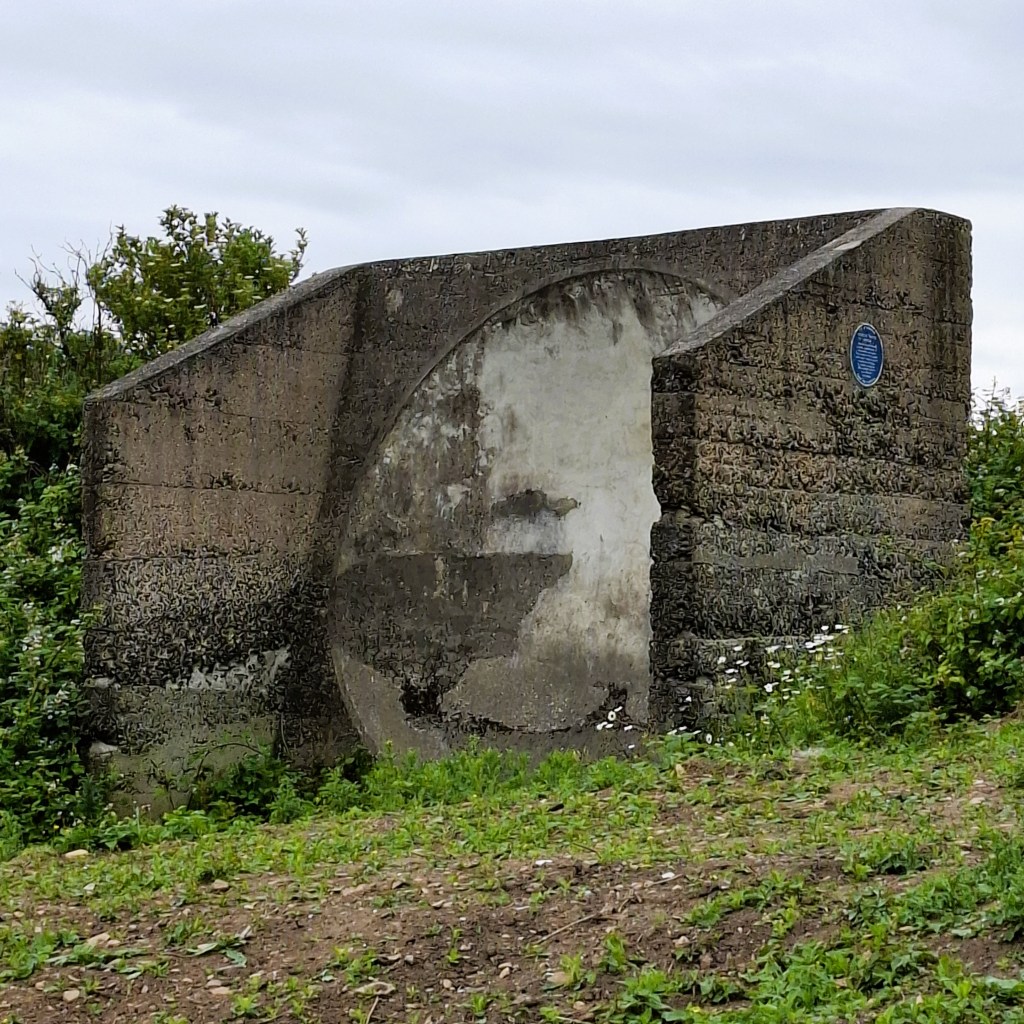
Songs For Dying Stars begins with an example of the capturing of the unheard frequencies that surround us – a recording of an Acoustic Mirror. The mirror was designed to act as an acoustic early warning system against air raids, by reflecting sound detected by a microphone placed in front of the dish where an operator, through headphones could alert the authorities of approaching Zeppelins. Here in Sunderland we are privileged to have an original sound mirror from WW1 and you can hear the sound frequencies it picks up via an emf sound recorder and is the basis of this track.
Secondly, there are two major influences that run through much of my soundwork, – memories and static, be it electrical sounds or radio waves.
Recently, I was listening to a radio programme about Cosmology and was blown away by the thought that the radio static that I love so much, and have done since a child, is what is referred to as Cosmic Microwave Background (CMB), the sound of electromagnetic radiation left over from an early stage of the universe in Big Bang cosmology. It is also called “relic radiation” and makes up 1% of the static radio noise and if you tune your TV between the stations, the static on the screen is from the big bang fireball.
Cosmic Microwave Background (CMB), the radiation from approximately 300k-400k years after the Big Bang, is also composed of thermal noise and other electronic noise from the radio receiver’s input circuits, and by interference from radiated electromagnetic noise picked up by its antenna, such as the microwave, electric razor or next door’s power tool being used nearby. And this is why I love static sounds.
For me, Sound is deeply ingrained with memory. People, places, time, milestones and the memories they invoke, all have a soundtrack. I have only seen the Milky Way once. It was a long time ago and on a visit to the Lake District, I lay flat, facing upwards on a shingle lakeside beach and marvelled at the sight of a billion dead and dying stars still shining and heard static and noise, ebbing and flowing, just like the pulsating Sun sonification at the end of the track.
Sound Mirror field recording courtesy of freekit and radio static from studioswastaken on FreeSound, used under the Creative Commons 0 License.
Radio static sounds are from my own large collection of electrical noises but I have also used samples of the sounds of Ganymede and our Sun from the audio files of NASA – @nasa on SoundCloud. Use of the sounds are under the Attribution-Non-commercial 3.0 Unported (CC BY-NC 3.0) details here – http://www.creativecommons.org/licenses/by-nc/3.0/
Artwork and photograph by Museleon

